

The FIFA World Cup Trophy: History, Design and Legend
The FIFA World Cup Trophy is the highest symbol in world football, and the moment it is lifted every four years is a memory shared by countless fans. What many people don’t realise is that the World Cup has actually had two different winners’ trophies, each carrying its own legend. This article walks you through where they came from, how they were designed, and the stories behind them.
The World Cup’s Two Trophies
From the first World Cup in 1930 to 1970, the winners received the Jules Rimet Trophy, named after FIFA’s first president, Jules Rimet. From 1974 onwards, the current FIFA World Cup Trophy took over and is still in use today. The two differ in shape, materials and ownership rules, marking two distinct eras in the history of the World Cup trophy.
The Jules Rimet Trophy: Legend and Theft
The Jules Rimet Trophy was designed by French sculptor Abel Lafleur, its form drawn from Nike, the Greek goddess of victory. Its story was eventful: before the 1966 World Cup, it was stolen during a stamp exhibition in London, and was eventually sniffed out under a roadside hedge by a dog named Pickles, a tale football still retells today. Under the rules, the first nation to win three titles could keep the trophy permanently, and Brazil, having won in 1958, 1962 and 1970, took it home for good in 1970. However, in 1983 the trophy was stolen again from the Brazilian football confederation’s headquarters in Rio de Janeiro; it has never been recovered and is widely believed to have been melted down.
The Current Trophy: Design and Materials
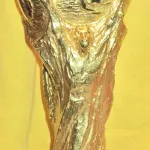
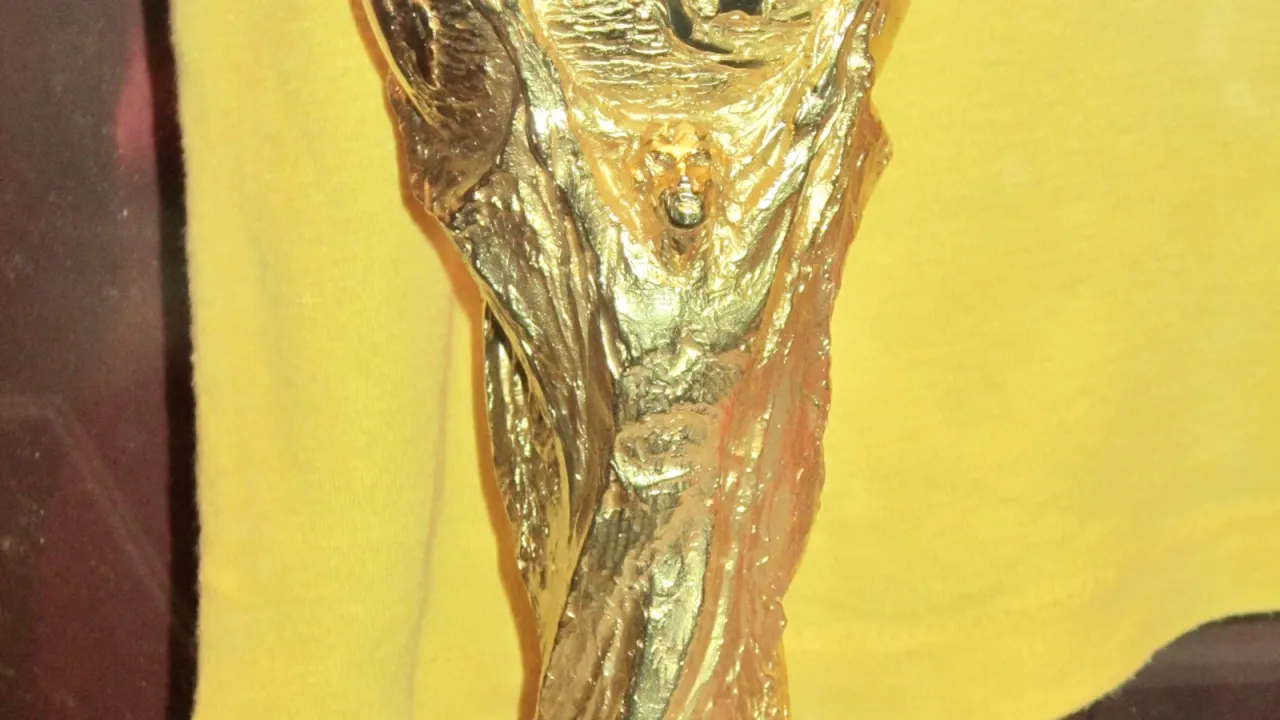
Introduced in 1974, the current trophy was designed by Italian sculptor Silvio Gazzaniga, whose entry was chosen from more than fifty submissions across seven countries. The trophy stands about 37 centimetres tall, with a body cast from 18-carat (75%) gold, and a base set with two layers of malachite, bringing the total weight to just over six kilograms. Its form shows two human figures holding up the Earth, the lines spiralling upward to symbolise lifting the highest honour in world football.
Can Winners Keep the Trophy?
Unlike the Jules Rimet Trophy, the current trophy is no longer kept permanently by any team. The winning side lifts the original at the ceremony, but what they take home afterwards is a gold-plated replica, while the original always stays with FIFA. The base has space engraved with the names of past champions, and by design that space can be used until around 2038, when the base will need to be replaced.
The Trophy and the 2026 World Cup
The 2026 World Cup is jointly hosted by the United States, Canada and Mexico, expanded to 48 teams. Whoever ends up winning, lifting this golden trophy on final day will be the proudest moment in their history. Knowing where the trophy came from and how it was made helps you appreciate the century of weight bound up in that single lift when you watch the final.
FAQ
Q: How many winners’ trophies has the World Cup had?
A: Two. The Jules Rimet Trophy from 1930 to 1970, and the current FIFA World Cup Trophy from 1974 onwards.
Q: What is the current trophy made of?
A: A body of 18-carat gold, about 37 centimetres tall, with a base of two layers of malachite, weighing just over six kilograms.
Q: Can the winning team keep the trophy permanently?
A: No. They receive a gold-plated replica, while the original is kept by FIFA.
For more, browse our World Cup section, or check the full fixtures and results page.